CFW Advisory | Global Business & Investment Insights | November 12, 2026
On November 12, NVIDIA announced that co-founder Jensen Huang had resigned as President, CEO and a member of the board. CFO Colette Kress was named interim CEO, and Harvey C. Jones became board chair. Market reports indicated that NVIDIA shares fell as much as approximately 14% in early trading. That was an intraday move—not a statement about the closing price.
The headlines are significant. But for founders, investors, suppliers and strategic partners, the more durable question is this: can a business continue to serve customers, allocate capital and execute its commitments when a key leader or counterparty changes?
1. Key-person dependency is a commercial risk, not only a governance issue
Founders can be a company's greatest asset. They establish product direction, culture, relationships and access to capital. Yet when the same individual is also the decision bottleneck and the primary bridge to major customers, the company may face operational fragility. This deserves attention in commercial diligence and long-term business planning.
A practical review should ask who owns the top customer relationships, who can approve a major delivery or spending decision, whether the second-line team can operate independently, and whether business-critical knowledge has been institutionalized. Board duties, governance documents and legal obligations belong with qualified counsel; operating dependency and continuity planning are areas for business advisers and management teams.
These questions matter to family-owned companies, founder-led manufacturers, cross-border joint ventures and private-equity portfolio businesses just as much as to large publicly traded technology firms.
2. The AI value chain can transmit uncertainty through commercial dependencies
AI infrastructure is a network of dependencies: chips, servers, cloud platforms, data centers, grid connections, transformers, cooling equipment, energy storage, construction contractors and financing partners. Each business depends on others to deliver on time and under workable commercial terms.
A major participant's leadership transition may prompt counterparties to revisit milestones, purchasing plans and financing assumptions. But it would be incorrect to infer that NVIDIA's customer contracts or product delivery have already stopped. NVIDIA's official statement says it expects operations, customer commitments and its product roadmap to continue without interruption.
For suppliers and operators, the useful questions are concrete: How much revenue depends on the top five customers? Are payment milestones tied to acceptance? Is there a second source for critical components? Who handles installation, warranty and service in the United States? What happens to working capital if a major project is delayed by one quarter?
3. Large capital commitments are not the same as executable cash flows
AI investment announcements often feature remarkable numbers. Yet individual projects ultimately depend on power access, permitting, construction progress, equipment delivery, customer demand and financing costs. Short-term market volatility does not prove an equivalent impairment in underlying assets; it does invite a renewed review of the assumptions behind an investment thesis.
For industrial investors and family offices, commercial diligence should focus on three connected questions: What independently verifiable evidence supports the projected market and contractual demand? Do payment schedules and milestones match the cash required to execute? After the acquisition or investment, who is accountable for integrating teams, suppliers and operating procedures?
4. Cross-border growth requires clear boundaries between commercial and regulated services
Advanced computing and semiconductor trade may be subject to export controls, end-user restrictions and other regulatory requirements. At the same time, lawful cross-border relationships or a company's national background should never be treated as evidence of wrongdoing. Effective projects assign commercial strategy and execution to business teams, while qualified legal, tax and other regulated professionals handle matters requiring their licenses and expertise.
CFW does not replace outside counsel, CPAs or regulated securities and transaction intermediaries. We help translate business objectives into U.S. customer development, partner selection, operational planning and accountable implementation, coordinating with those specialists as needed.
5. Where CFW Advisory can contribute
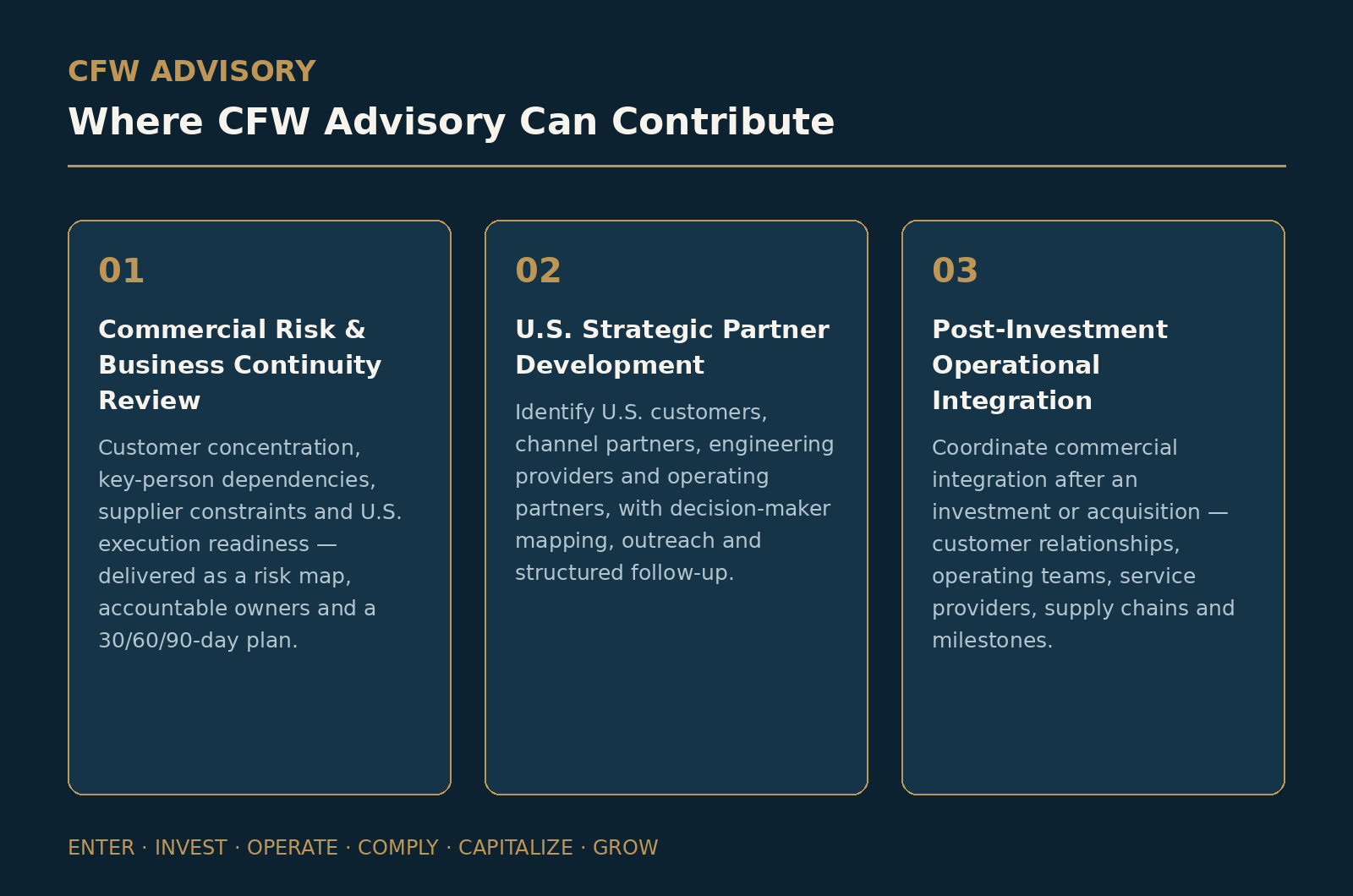
Commercial Risk & Business Continuity Review: assess customer concentration, key-person dependencies, supplier constraints and U.S. execution readiness; deliver a risk map, accountable owners and a practical 30/60/90-day plan.
U.S. Strategic Partner Development: identify relevant U.S. customers, channel partners, engineering providers and operating partners; support decision-maker mapping, outreach and structured follow-up without implying an introduction already exists.
Post-Investment Operational Integration: coordinate commercial integration after an investment or acquisition across customer relationships, operating teams, service providers, supply chains and milestones. Legal documents, regulated financing and securities transactions remain with appropriately qualified professionals.
6. Three questions worth asking this week
If a key executive were unavailable tomorrow, who would own the top ten customer relationships? If a strategic technology partner changed course, could the company respond within 90 days? If a deal closed today, who would be accountable for U.S. delivery, cost, timing and customer outcomes?
Business resilience is not a slogan. It is a system of accountable people, customer relationships, workable contracts, operational capacity and cash-flow discipline. Building that system should be part of investment and growth strategy—not something deferred until a crisis.
CFW Advisory LLC | ENTER · INVEST · OPERATE · COMPLY · CAPITALIZE · GROW
For business inquiries about U.S. commercial partnerships, operational continuity and post-investment execution, please contact CFW through its official channels. General business commentary only; not legal, tax, securities or investment advice.
Sources:
NVIDIA Announces CEO Transition (November 12, 2026): https://investor.nvidia.com/news/press-release-details/2026/NVIDIA-Announces-CEO-Transition/
NVIDIA news archive (November 8 board statement; November 10 update): https://nvidianews.nvidia.com/news/?c=21926
Share-price reporting (intraday, approx. 14%): https://www.businesstimes.com.sg/companies-markets/global-ai-stocks-sink-nvidia-ceo-jensen-huangs-exit-deepens-sector-sell